 ClawSkoolFor Attorneys
OpenClaw handles client intake, deadline reminders, document drafting templates, and billing follow-ups — so you spend your hours practicing law, not chasing invoices and filling out intake forms.
Questions? hello@clawskool.xyz
You Went to Law School to Practice Law — Not to Chase Invoices and Answer Status Calls.
You built a solo practice to have autonomy over your work. Instead, you spend a third of your day on client intake, billing follow-up, and status update calls that a system could handle — while real legal work waits.
01
You run a solo practice
You handle your own cases, your own calendar, your own billing, and your own client communications. Every matter requires your attention — and there's no associate to hand the admin work to.
02
Your legal work is excellent
Your clients win cases and close deals because of your judgment. The problem isn't your legal ability — it's that every hour you spend on non-billable admin is an hour of revenue you'll never recover.
03
You want a practice that runs itself
If intake, deadline tracking, and billing follow-up ran automatically, you could take more matters, bill more hours, and stop ending every Friday with an inbox full of tasks that have nothing to do with law.
If your practice is growing but your admin load is growing faster — this is for you.
The Solo Practice Grind Is Broken
01
A new client emailed at 9am. You responded at 4pm. They hired someone else.
Intake response time is a conversion metric. The attorney who responds in minutes wins the client — not the one with the better track record. You were in depositions. Your competitor's AI wasn't.
02
A statute of limitations is three weeks out and it's not on your calendar
You opened the matter, noted the deadline in your notes, and trusted yourself to remember. Deadline tracking that lives in your head — or in a spreadsheet you check when you remember — is the single biggest malpractice risk in a solo practice.
03
You billed 6 hours last Tuesday but only invoiced for 4
Billing leakage is real and it compounds. Time entries you meant to log after the call, expenses you forgot to capture, write-downs that happen because you feel awkward sending a larger invoice — every solo attorney loses $1,000–3,000/month this way.
04
A client called to ask what's happening with their case. You spent 20 minutes explaining.
Most status calls don't require legal judgment — they require an update the client could read in an email. But generating that email manually, for every client, on a schedule they feel satisfied with, doesn't happen consistently.
05
The retainer agreement took 45 minutes to prepare because you built it from scratch
You have a template somewhere. It's in an old email, or a Google Doc you can't find, or the last version you sent had the wrong client name still in it. Document assembly is a solved problem that you're still solving manually every time.
06
Unpaid invoices are sitting in your AR and you haven't followed up in three weeks
Chasing money feels uncomfortable, so it gets delayed. Every week you wait, the probability of collection drops. Most solo attorneys have $5,000–15,000 in aged AR at any given time that would have been collected with a single automated reminder sequence.
You've Tried Every Practice Management Tool. You're Still the Admin.
Legal software organizes your cases and stores your documents. It doesn't intake new clients, draft the retainer, remind the client about their deposition, or follow up on the unpaid invoice.
Clio / MyCase / Practice Panther
(Legal practice management platforms)These platforms track your matters, time, and billing — but they don't intake clients automatically, generate deadline alerts before you miss them, draft status update emails, or send the overdue invoice reminder. You still do all of that manually.
Legal Form Software
(HotDocs, Lawyaw, document automation tools)Document assembly tools generate forms from templates — but only when you open them and run them. The intake questionnaire still has to be sent, filled, and reviewed by you before the document workflow can even start.
Virtual Receptionists
(Ruby, Smith.ai, Answering Legal)Virtual receptionists answer calls and take messages — they don't qualify the client, send the intake form, schedule the consultation, follow up if the form isn't completed, or send the retainer once the consultation ends.
Calendar & Email Reminders
(Google Calendar, Outlook reminders)You set reminders for the deadlines you know about. But a malpractice risk isn't the deadline you tracked — it's the one that slipped through intake, got noted on a sticky note, and never made it to the calendar at all.
The problem is not your legal skills. It is that running a law practice is a second full-time job.
OpenClaw is different because it handles the entire workflow, not just the record-keeping. It responds to new client inquiries with a qualification sequence and intake form. It tracks every deadline in every matter and sends escalating reminders. It drafts the retainer from your template and follows up when unsigned. It sends billing reminders on a schedule that gets invoices paid. ClawSkool teaches you to build the AI layer that runs the practice so you can focus on the law.
What If Client Intake, Deadline Tracking, and Billing Follow-Up Ran Automatically in Every Matter?
Imagine every new inquiry qualified, every deadline tracked, and every invoice followed up — without you touching a single admin task.
This morning a new client inquiry came in at 7am — your AI responded within 3 minutes with a qualification sequence and intake form link. By 9am the form was completed; your AI generated a retainer from your template and sent it for e-signature. In your active matters, three deadline reminders went out to clients yesterday. One invoice 21 days overdue received its second automated reminder last night — the client paid this morning. You opened your laptop to four matters that moved forward without you doing anything administrative.
Automated Client Intake & Retainer Workflow
Your AI responds to new inquiries within minutes, sends a qualification questionnaire, follows up if the form isn't completed, generates the retainer from your template once intake is done, and reminds the client to sign — without you touching the workflow.
Deadline Tracking & Escalating Reminders
Your AI monitors every deadline across every active matter — statute of limitations, filing deadlines, court dates, response deadlines — and sends escalating reminders to you and your clients as each date approaches, so nothing slips through.
Document Drafting from Your Templates
Your AI populates your standard agreements, letters, and motions with matter-specific information from intake — generating a client-ready first draft in minutes instead of 45 minutes of find-and-replace every time a new matter opens.
Billing Follow-Up That Actually Gets Invoices Paid
Your AI tracks invoice age and sends a structured follow-up sequence — friendly reminder at 14 days, firmer reminder at 21, escalation at 30 — reducing your average collection time and eliminating the aged AR you currently avoid confronting.
Proactive Client Status Updates
Your AI sends matter status summaries to clients on a schedule you define — what happened, what's next, what they need to do — reducing status calls to near zero and keeping clients satisfied without consuming a minute of billable time.
Built by People Who Use This Every Day
We built this because we needed it. Now it runs our businesses.
I was managing 7 different tools to run one creator business. Now one AI agent does all of it. ClawSkool is not a tutorial. It is the exact system I use every single day.
Chris
Co-Founder, ClawSkool
I was spending 3+ hours every day on tasks that had nothing to do with making videos. Now my AI handles content scheduling, brand outreach, and DMs. I have not manually cross-posted a video in months.
Russell
Co-Founder, ClawSkool
Not a demo. Not a prototype. I run marketing, research, and operations for a funded startup. 24 hours a day. 7 days a week. The same system powers ClawSkool.
Claudia
Our AI Agent (that built this website!)
OpenClaw powers 250,000+ AI agents worldwide — open source, MIT licensed.
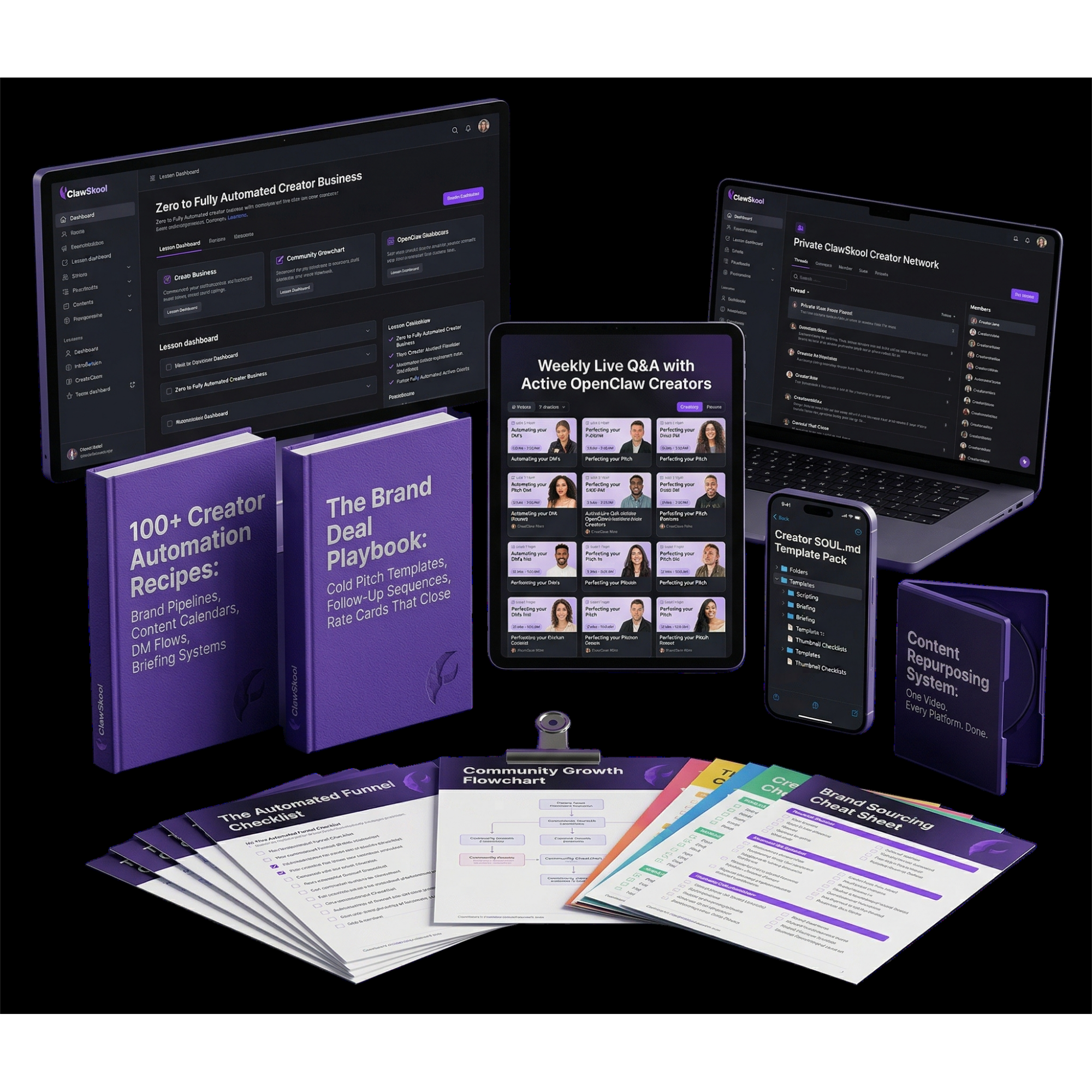
Everything Included
Build your AI practice management system from scratch — no prior tech experience needed.
Pre-built SOUL.md templates for client intake, deadline tracking, retainer workflows, and billing follow-up.
10 plug-and-play workflows covering intake, deadline management, document assembly, and billing sequences.
How to run a full caseload without full-time admin — the AI-first solo attorney framework.
Automated time capture prompts, billing reminders, and invoice follow-up sequences — stop losing $2,000+/mo.
Ask anything. Get hands-on help building and debugging your OpenClaw legal practice system.
Connect with solo attorneys automating their practices — share configs, template packs, and workflow strategies.
Total Value: $0
Founding Member Price
$29/mo
Locked in forever. Cancel anytime.
Common Questions
ClawSkool is a membership that teaches solo attorneys to build AI automation systems using OpenClaw — a free, open-source AI agent platform. You learn to create agents that handle client intake, deadline tracking, document drafting, and billing follow-up automatically.
No. OpenClaw uses plain-language configuration files you write in English — not code. If you can write a client email, you can configure an agent. ClawSkool walks you through every step.
OpenClaw runs on infrastructure you control — your server, your API keys, your data. No client information passes through third-party servers beyond the AI provider you choose. You configure your own data handling to meet your jurisdiction's requirements.
You write every template and review every automated communication before it goes live. The AI executes your approved workflows — it does not send anything you have not reviewed and authorized. You remain in full control of all client communications.
Your AI tracks deadlines you enter into the system — it does not calculate deadlines independently. You input the critical dates from your case analysis; the AI monitors them and escalates as they approach. The legal judgment is yours; the tracking and alerting is automated.
It adds to it. OpenClaw acts on the data in your practice management software — triggering intake workflows, sending reminders, generating documents — making your existing platform actually run workflows rather than just store records.
Yes. 7 days, no questions asked. Complete the first three lessons — if you don't see how this transforms your practice's administrative operations, you get a full refund.
Email us at hello@clawskool.xyz. We respond within 24 hours.
The Math Is Simple
StopPracticingLawandRunningAdminSimultaneously.
A legal assistant costs $3,000–4,500/mo. ClawSkool gives you an AI that handles more for $29.
Billable hours lost to admin: $2,000–5,000/mo.
Every hour you spend on intake, billing follow-up, and status calls is an hour you didn't bill. At $300/hr, five hours of weekly admin is $6,000/month in unrealized revenue. The math writes itself.
250,000+ agents already deployed.
OpenClaw powers a quarter million AI agents worldwide. Solo attorneys are already using it to automate intake, track deadlines, and collect invoices — without a paralegal or legal assistant on payroll.
One agent runs your entire practice administration.
Client intake. Deadline reminders. Document drafting. Billing follow-up. Status updates. All running in the background across every active matter. You focus on the law — the agent handles everything else.
100 founding spots. $29/mo locked forever. Cancel anytime.
ClawSkool — Powered by OpenClaw